



What is the carbon ROI on thermal renovation works for an office?
As the real estate market undergoes profound changes amid rising raw material prices and interest rates, renovation is experiencing strong growth in France and Europe and has a promising future. Renovation seems to be the solution to align with increasingly stringent decarbonization requirements for the sector. This is true, but not without studying the carbon Return on Investment (ROI) of the works, to ensure their energy and carbon coherence.
As a reminder, the carbon ROI of renovation works corresponds to the point in time when the greenhouse gas emissions generated by a renovation scenario become lower than those of the initial scenario.
For more information, see our article on the subject: Carbon Payback Period (CPP).
Study of the carbon ROI of thermal renovation works on two systems
In this article, we aim to highlight the carbon ROI of several energy renovation plans for an office building in Paris.
Building Modeling
We modeled the physical and thermal characteristics of an old office building in Paris using a thermodynamic engine developed by Deepki (https://www.deepki.com).
Some information about the studied building:
- Office
- Built in the 1900s
- No air conditioning
- Heating with electricity in one case, gas in the other
- Surface area of 5,000 m²
For these two systems, we calculated the carbon ROI of thermal renovation actions aiming to:
- Improve insulation
- Change the heating system in the case where the office is heated by gas
Case Studies
Office #1 – Electrically heated
Summary of the modeling
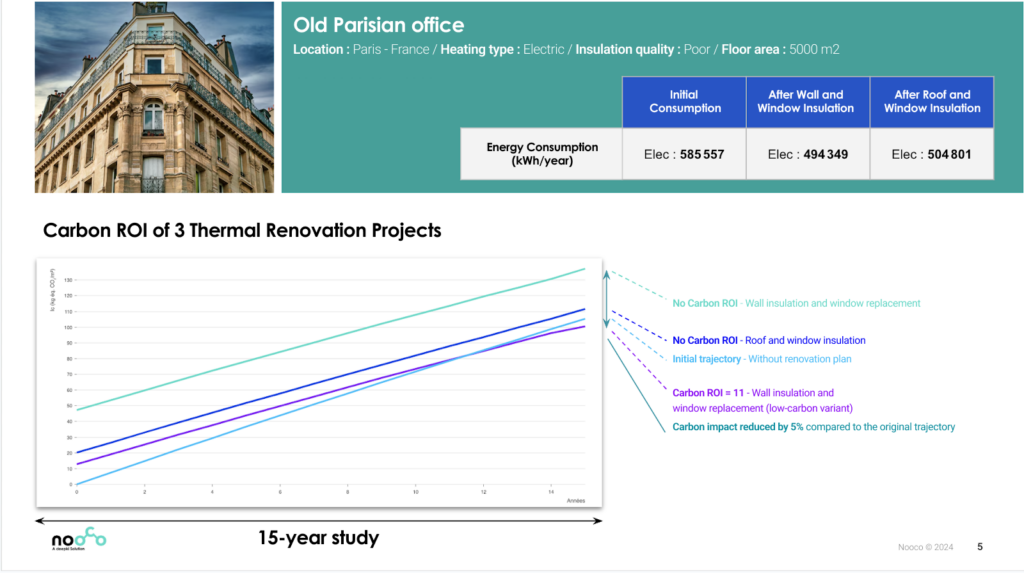
Analysis of the modeling
→ We observe that there is no carbon ROI for the two renovations despite the reduction in energy consumption they generate:
- This is mainly due to the use of Default Environmental Data (DED) in the modeling, which corresponds to highly carbon-intensive materials.
- It is also explained by the energy vector used to heat the building. Electricity has a relatively low carbon impact, especially in France, and the reduction in consumption resulting from the thermal renovations is therefore not sufficient to offset the added carbon from installing new materials in the studied cases.
→ A ROI is achieved after 11 years by implementing a variant of the wall and window renovation using low-carbon equipment. This reduces the carbon impact by 5% compared to the original trajectory with a low-carbon variant, in addition to reducing the building’s energy consumption by 16%.
Office #2 – Gas Heated
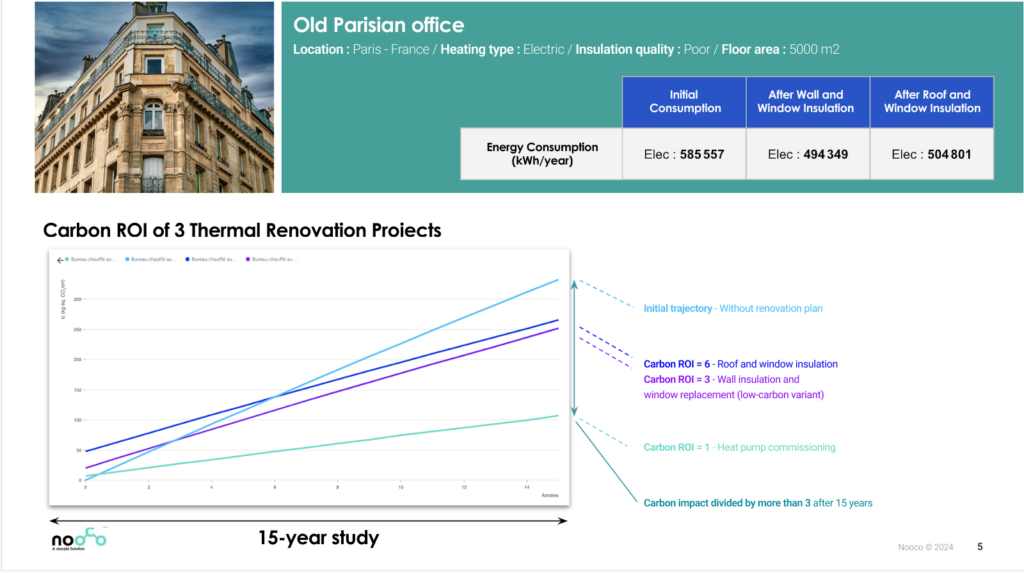
Analysis of the modeling
→ For a gas-heated building, a carbon ROI is achieved in all modeled scenarios, explained by:
- The reduction in gas consumption (which is particularly carbon-intensive) when insulating parts of the building
- Carbon ROI of 6 years by insulating the roof and windows
- Carbon ROI of 3 years by insulating the walls and replacing the windows
- The switch from gas to electricity for heating production, electricity being much less carbon-intensive in France
- Carbon ROI of 1 year by installing a heat pump
→ All scenarios lead to a reduction in the building’s carbon impact in addition to lowering energy consumption:
- The scenario involving the installation of a heat pump results in a 68% reduction in carbon impact after 15 years, alongside a 38% decrease in the building’s energy consumption.
Conclusion
We observed that the modeling of scenarios leads to quite different results:
- Depending on the type of heating system: a carbon ROI is achieved for all our renovations when the building is gas-heated. This is less clear for an electrically heated building.
- Depending on the carbon impact of the equipment and materials installed during renovations: in the electrically heated building, no carbon ROI was obtained when installing carbon-intensive materials. We highlighted that a ROI is achievable by using the lowest-carbon equipment available on the market.
Thermal renovation is generally a good solution from an energy standpoint when a building is poorly insulated, but carbon gains are not automatic. It is necessary to consider the building’s baseline characteristics and the carbon impact of the added equipment.
To evaluate or question the relevance of renovation work, Nooco is a tool that reconciles energy and carbon approaches to promote pragmatic choices for the environment.