



Carbon Payback Period (CPP)
In the context of renewable energy projects, renovations, or general comparisons between construction variants, it has become necessary to develop indicators for analyzing carbon data. Carbon Payback Period (CPP) is one such indicator among many, providing a practical means of comparing projects with a concrete unit of years.
Origin and Purpose of the Indicator
An Increasingly Restrictive Regulatory Environment
The French construction market is currently experiencing a rapid evolution of its regulatory framework, with the gradual implementation of environmental regulations for new buildings (RE2020) and ambitious targets for reducing the carbon impact of buildings.
Limitations of Energy Indicators
For a long time, the focus of eco-design efforts has been on energy performance, despite the greenhouse gas (GHG) emissions generated. However, energy and carbon indicators do not always evolve in parallel.
The use of Life Cycle Assessment (LCA) calculations is therefore increasingly being adopted early in projects, encouraging decision-makers to consider both energy and GHG emissions over time generated by construction.
What is Carbon Payback Period?
Definition
It is within this context that the Carbon Payback Period (CPP) becomes relevant, as it allows for projecting carbon emissions over time.
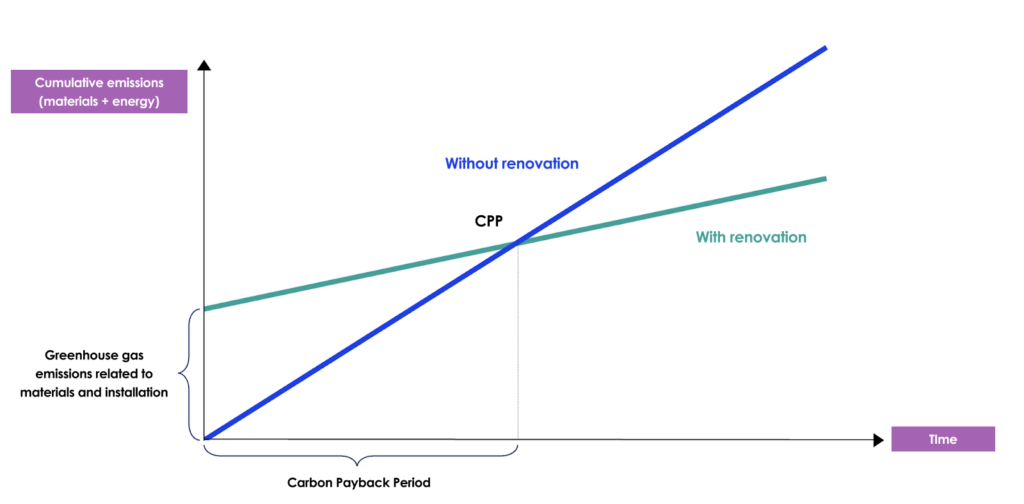
CPP corresponds to the time required for the cumulative greenhouse gas (GHG) emissions generated by a system over its entire life cycle to become lower than those of an existing system. In practical terms, it is the carbon “payback period” of a project, calculating the time needed to offset the initial carbon investment.
Concept of Carbon Payback Time Associated with a Renovation Project
Limitations of the Carbon Payback Period (CPP)
The CPP remains a relative indicator. It does not indicate whether a project falls within regulatory carbon thresholds. It is entirely possible to compare two projects with high carbon impacts (above standards), where one has a relatively lower impact than the other. In this case, it will have a shorter CPP.
By the end of the year, we plan to study the CPP of flagship energy renovation projects, starting with photovoltaic solar panel installations.
Further Reading on Carbon Payback Period (CPP): The carbon payback period (CPP) of a photovoltaic solar panel installation