Carbon Payback Period (CPP) of a Relamping Project
Lighting represents a significant share of energy consumption in France due to its omnipresence in our daily lives. Whether in our homes, streets, offices, or industries, the French electricity mix allocates a substantial portion to lighting: in 2021, it accounted for 10% of the national electricity consumption according to ADEME. Therefore, there is a strong need to optimize the energy used by our lighting systems, as electricity not consumed means less carbon emitted.
Over the past decades, lighting has undergone considerable transformations, shifting from traditional light sources such as incandescent and halogen bulbs to more efficient technologies, notably fluorescent lamps and LEDs. These developments align with the trend toward favoring less energy-intensive lighting solutions.
We observe a proliferation of lighting technologies, accompanied by a growth in their energy efficiency. While this energy aspect is well documented, there remain gray areas regarding the carbon impact of manufacturing luminaires. Carbon data is still incomplete, although it continues to improve within a broader life cycle analysis framework. This will be the focus of our study in this article, with particular attention to the relamping operation.
Relamping and Its Benefits for Reducing the Carbon Impact of Buildings
Relamping, or lighting renovation, is the practice of replacing old lighting sources with more efficient and energy-saving technologies such as LED bulbs, compact fluorescent lamps (CFL), or high-efficiency lamps. Regulations have emerged, and in 2018, halogen lamps were banned, which helped to highlight the relamping process.
Relamping is a key lever for reducing the carbon footprint of lighting for several reasons:
Longer lifespan of LEDs: This means fewer replacements are needed, and consequently, lower emissions related to manufacturing, transport, and disposal of new lighting fixtures.
Possibility of intelligent control and management: Modern lighting systems can be paired with management devices that optimize usage and reduce unnecessary lighting.
Reduction in energy consumption: New technologies such as LEDs consume less electricity than traditional bulbs. By using less electricity, LEDs reduce associated GHG emissions.
As an illustration, by replacing all conventional lamps in its metro stations with LEDs, RATP has halved the electricity consumption of its stations and terminals, resulting in an annual saving of 77 GWh.
Note : Relamping is a solution to reduce electricity consumption and carbon footprint. However, it is important to emphasize that it should not conflict with a fundamental approach to reducing overall lighting usage. Lighting contributes to light pollution, which leads to other issues affecting health and biodiversity in general.
We have discussed the energy aspect of lighting. Now, let’s turn our attention to its carbon footprint across the different phases of its life cycle…
Luminaire breakdown and carbon footprint throughout its life cycle
A luminaire consists of the lighting technology (halogen, compact fluorescent, LED) and the materials making up the fixture. Given the current data, it is difficult to isolate these two components: carbon accounting is relatively recent and does not always exist at the desired level of detail, especially since the carbon footprint of bulb technologies varies.
The energy efficiency of LEDs is well known and translates into a reduced carbon impact during the usage phase compared to halogens. However, there remain uncertainties regarding the manufacturing phase of a luminaire and its embedded carbon. Without claiming to provide a universal analysis of the carbon composition of a luminaire, we will examine the makeup of a luminaire based on a Default Environmental Data (DED) profile. This particular luminaire is a linear recessed fixture typically installed in offices, commercial spaces, etc.
In this example, aluminum is the main component of the luminaire’s structure and the largest source of carbon impact:
The emission factor for aluminum is 9.503 kg CO2 eq/kg (source: Ecoinvent).
The carbon impact of aluminum thus amounts to 64.6 kg CO2 eq, representing 54% of the carbon footprint of the studied luminaire.
The bulb itself accounts for a relatively small share of the carbon footprint. It is the materials used to manufacture the luminaire that contribute the most.
The volume of verified LCAs available does not reflect the diversity of products on the market.
The available data is still limited. Below are some limiting factors as examples:
The quantity and precision of available data: On INIES, there are still few Product Environmental Profile (PEP) sheets, meaning data published by a manufacturer and certified by an external body. The available data is generic and not exhaustive in terms of carbon impact details.
Data comparability: On Ecoinvent, the carbon footprint of a compact fluorescent lamp is given per unit (3.94 kg CO2 eq per unit), whereas that of an LED is given per kilogram (260 kg CO2 eq). Comparing technologies is therefore tricky, even though it remains possible by accepting some approximations, which we chose not to do.
A process of database improvement is underway
We observe an acceleration in the transparency of carbon footprint calculations through the publication of verified data sheets. The INIES database has seen a strong increase in the number of available sheets between the end of 2021 and the end of 2022. The number of PEP sheets is lower, mainly due to the complexity of the certification processes. However, the production of these sheets is speeding up, with as of December 31, 2022:
3,536 FDES (+43% compared to December 31, 2021)
811 PEP (+54% compared to December 31, 2021)
Energy remains the primary lever to reduce the carbon footprint of lighting
Today, the main lever emphasized to reduce the carbon footprint of lighting is energy consumption. This makes sense since the carbon impact of luminaires is largely driven by the operational phase: in the cases we studied, over 90% of the luminaire’s carbon footprint is linked to electricity consumption (based on Ecopassport PEP data sheets).
This figure holds true in France, where the energy mix is relatively low-carbon due to the predominance of nuclear power. However, it is likely underestimated in countries with more carbon-intensive electricity mixes. For example, in Germany in 2022, the emission factor related to electricity consumption was 0.434 kg CO2 eq/kWh, compared to 0.0533 kg CO2 eq/kWh for France—almost eight times lower (sources: Allemagne-Energie and ADEME).
Case Study: Carbon Payback Period (CPP) of Relamping a Shopping Mall
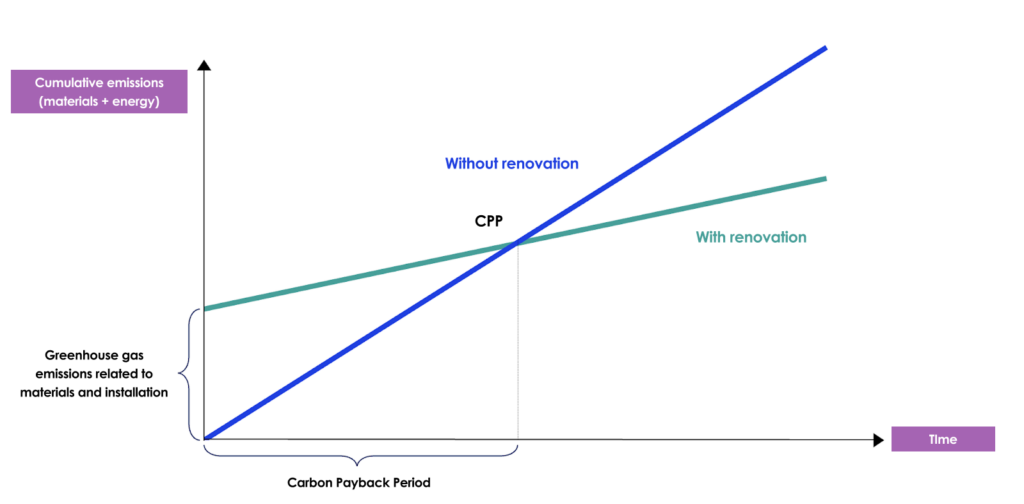
To begin, a brief reminder about the concept of Carbon Payback Period (CPT) that we presented on our website. The Carbon Payback Period corresponds to the time needed for the cumulative greenhouse gas (GHG) emissions generated by a new system over its entire life cycle to be offset by the emissions saved compared to the system previously in place. In concrete terms, it is the calculation of the carbon “return on investment” time for a given operation.
Carbon Payback Period Concept Applied to a Renovation Project
Presentation of the Parameters
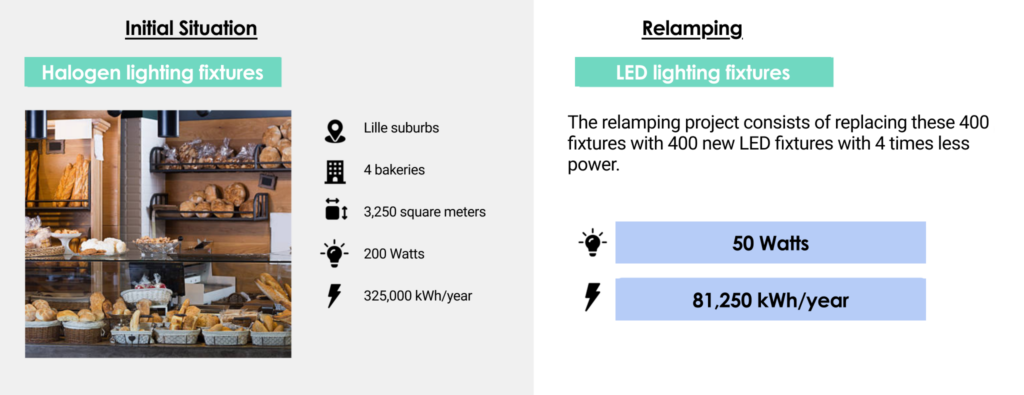
We consider the case of replacing the lighting system in four commercial premises. In a domestic setting, it is common to replace only the bulb in a fixture. In contrast, in commercial spaces like these, it is often necessary to replace the entire luminaire because the bulbs are sized and integrated into their supports.
We focus on the most common relamping scenario: replacing halogen lamps, which have been banned from sale since 2018, with LED panels, currently the most widely installed technology.
Comparison of the two scenarios
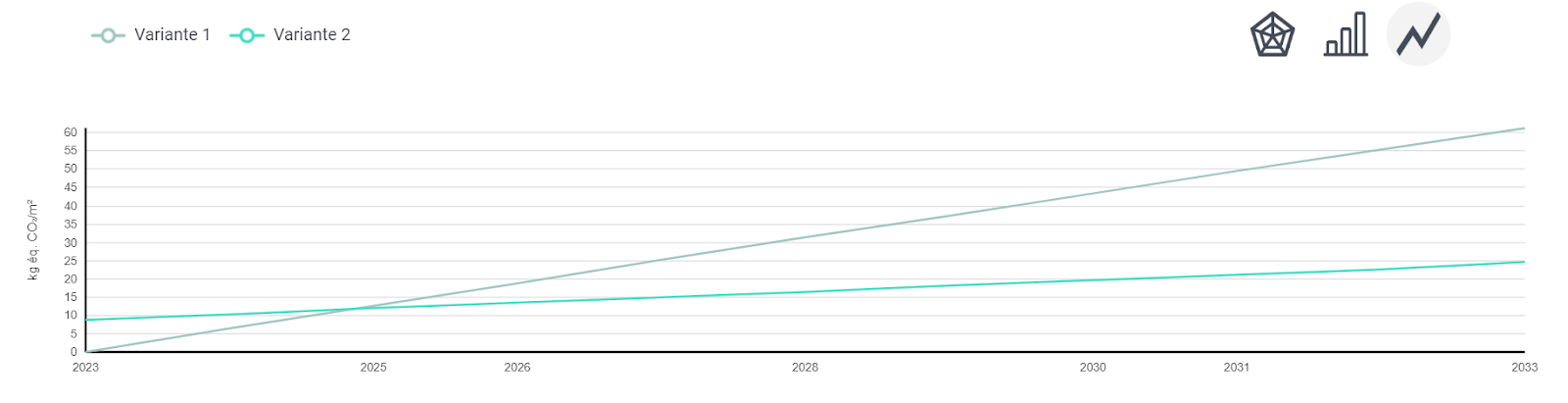
With these assumptions, we plot the temporal evolution of the carbon impact per square meter of building:
The dark green curve represents the case where the old luminaires are kept without adding any additional materials, thus without adding initial carbon.
The light green curve represents the case where the luminaires are replaced, which involves an addition of material upfront before the operational phase.
At T=0, the LED project has a higher impact than the existing lighting system. This is due to the carbon footprint from manufacturing the new LED luminaires.
At T=2, the carbon impact of the halogen variant surpasses that of the LED variant. This is the carbon Payback Period, the point from which the LED project emits less than the existing lighting system. The rapid catch-up of the project is due to the much higher energy efficiency of LEDs (consuming 4 times less), which reduces electricity use for the same level of lighting.
At T=10, assuming in our hypotheses that the halogen luminaires did not need to be replaced, the carbon impact of the existing halogen system is 2.4 times higher than that of the LED project.
We observe that the initial carbon impact of the relamping project is quickly amortized and is significantly lower than that of the existing lighting system after 10 years. Beyond the carbon aspect, relamping is an affordable and profitable solution for investors: LEDs have a longer lifespan and reduce electricity bills. However, it remains important to adopt a project modeling approach to ensure their relevance both in terms of carbon impact and energy efficiency.
And while data gaps still exist, the available data are increasingly numerous and precise, benefiting all actors in the value chain by improving understanding and management of the true carbon footprint of products.
Going further with low-carbon luminaires
In the building sector, and particularly for lighting, there is increasing focus on reuse practices. This is indeed a very interesting solution to effectively reduce the carbon footprint of offices or homes, approaching a near-zero carbon operation (except for transportation, storage, and installation).
This approach, which fits within a broader circular economy strategy, is particularly relevant in commercial buildings where tenant turnover is high. The share of lighting fixtures from reuse is growing alongside improving expertise in reintegrating luminaires into buildings. However, the reuse process is currently slowed down by regulatory and insurance frameworks, which are adapting to new challenges linked to the use of “second-hand” lighting fixtures.
Ultimately, whether it’s relamping or reuse, the key is to choose the approach that best fits the need, and to multiply, whenever possible, the means to reduce carbon impact.