



Challenges of harmonizing building Life Cycle Assessment (LCA) across Europe
Building Life Cycle Assessment (LCA) is currently evolving across Europe, with a strong focus on moving beyond simple energy analysis to encompass emissions throughout the entire building lifecycle. However, to date, there is no harmonized global methodology. Approaches remain fragmented, with methodologies varying from one country to another. This diversity complicates standardization and comparison of environmental impacts at the European level.
Regulations and labels in Europe: an insufficient framework for building LCA
In Europe, there are various labels, directives, and regulations that provide some structure for carbon calculations.
We have categorized these different European regulations and labels along two axes:
- Global / Niche: representing the scope of application, from local levels and/or a limited range of building types covered by the label (“Niche”) to a broader, international framework (“Global”).
- Check-box / Commitment: distinguishing minimal compliance approaches (“Check-box”) from initiatives aiming for a more ambitious commitment with transparent impact calculations (“Commitment”).
For example, RE2020 is positioned in the “Niche-Commitment” zone because it applies only in France and to new construction (Niche) while imposing an ambitious and transparent methodology (Commitment).
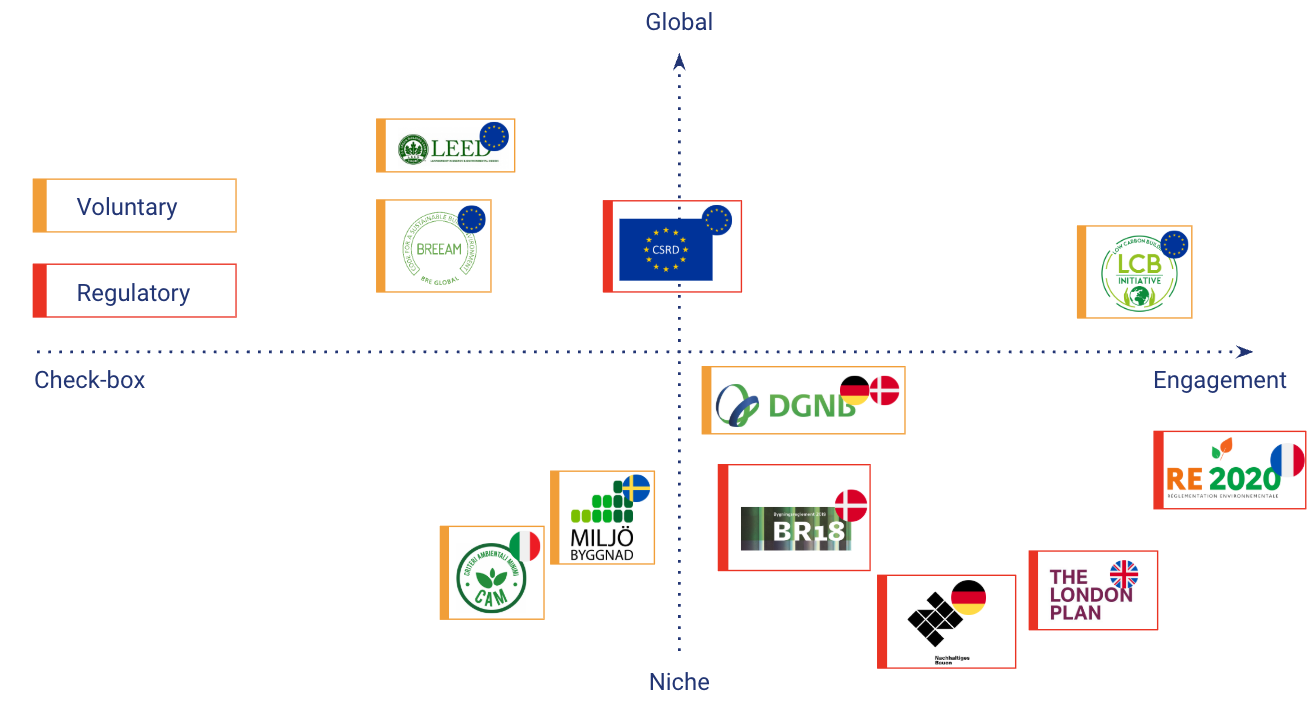
Overview (non-exhaustive) of regulations and labels in Europe
There is currently no binding European-wide regulatory methodology for building Life Cycle Assessment (LCA). This makes it difficult to measure and compare efforts between countries. The lack of standardization slows down the implementation of actions and limits the transparency needed to achieve ambitious climate goals.
Companies Commit Differently Despite the Lack of a Structured European Framework
Despite the absence of a common reference framework, strong commitments to reducing embodied carbon are multiplying among building sector players: VINCI Energies aims to cut its CO2 emissions by 40% by 2030 and achieve carbon neutrality by 2050. Nexity has set a goal to outperform the French RE2020 regulation requirements by at least 10% on average. Setec is committed to offering low-carbon solutions throughout the project lifecycle using decarbonized construction variants. Léon Grosse delivered the first French residential building labeled BBCA at the Excellence level. Saint-Gobain performs life cycle assessments on all their products…
Thus, many actors in the construction sector acknowledge the urgency to reduce the carbon impact of their activities, as well as to accelerate transparency and the reporting of extra-financial information in their annual reports (https://www.nooco.com/en/blog/carbon-footprint-monetary-ratios-or-lca/).
The LCBI Label: A Promising Solution for a Low-Carbon Transition at the European Scale
The LCBI (Low Carbon Built Environment Initiative) label is an initiative aimed at promoting low-carbon construction by providing a clear and structured methodological framework to assess and reduce the environmental impact of construction projects. As seen in the matrix, positioned at the top right, the LCBI label appears as the most suitable and ambitious solution. However, this label currently has limitations, as it focuses solely on new construction while neglecting renovation. Yet, including criteria for renovation is essential to address broader sustainability challenges: renovation remains underrepresented in its methodologies and standards, even though it accounts for a significant and substantial share of the real estate market.