



Key takeaways from RE2020
It has now been three years since the Environmental Regulation 2020 (RE2020) texts were published. Currently applicable only to individual houses, collective housing, offices, and primary and secondary schools, RE2020 has shaken up the construction landscape in France. All building sector stakeholders have aligned themselves to meet the new regulatory requirements. What can we take away from this regulation so far?
Early Trends
Since January 2022, when the regulation came into effect for single-family homes and multi-family housing, organizations such as IFPEB and the RE2020 Observatory have been collecting feedback from buildings subject to RE2020.
This effort helps establish best practices and options for meeting regulatory targets depending on building types, and it also informs the definition of requirements for buildings not yet covered by RE2020 but currently under construction.
As of August 1, 2024, the Observatory’s website has recorded over 330,000 building permits and more than 38,000 declarations of completion and compliance (DAACT).

Number of RE2020 Buildings Registered on the RE2020 Observatory
Early trends show that several projects aim for exemplary environmental performance. Indeed, some buildings already meet the requirements set for 2025 and even 2028, both for the Icenergy indicator and the Icconstruction indicator. However, for the latter, the use of Default Environmental Data (DED) remains relatively high and represents an area for optimization as environmental data from manufacturers’ products become available. In fact, DEDs have a significantly higher environmental impact compared to manufacturer-specific declarations.
All environmental data is available in the INIES database, which includes:
- Environmental and Health Declaration Sheets (FDES) for structural and building envelope elements
- Product Environmental Profiles (PEP) for elements from technical trades (HVAC, electrical low voltage, electrical high voltage)
What are the key levers to meet future thresholds?
As of January 1, 2025, the thresholds for the Icénergie and Icconstruction indicators will be adjusted and become more stringent, requiring the entire construction production chain to adapt to these new requirements.
The use of increasingly sustainable energy sources and renewable energies are key levers to meet the Icénergie requirements and are already well integrated into projects.
Regarding the Icconstruction indicator, the use of so-called “low-carbon” concrete, containing clinker-reduced cement, was initially seen as the inevitable solution to achieve the 2025 objectives. However, all building components must be optimized—not only the structural and envelope parts but also the technical trades. Indeed, the widespread adoption of bio-based materials, both in structure (mixed construction methods) and insulation, continues to grow and generates significantly fewer greenhouse gas emissions.
Another area for optimization concerns the technical trades. The E+C- label introduced flat-rate values for these trades, which in some cases penalize projects, and these flat rates have been carried over into RE2020. However, more and more manufacturers are producing Environmental Product Declarations (EPDs) for their products, allowing projects to avoid flat rates and the use of Default Environmental Data (DED), which can sometimes be more than three times higher than manufacturer data. Recent work from the Low Carbon Prescribers Hub shows that in tertiary buildings, detailed calculations can save carbon in lots 8.1, 8.3, and 9—that is, in HVAC production equipment, terminals, smoke extraction, and the entire high-voltage electrical lot.
For HVAC networks without reuse, the flat-rate is still too low to encourage detailed calculations. (source : ifepb)
Additionally, integrating reused products is a highly decarbonized alternative since they are counted as zero in the Life Cycle Analysis calculation according to the RE2020 calculation methodology.
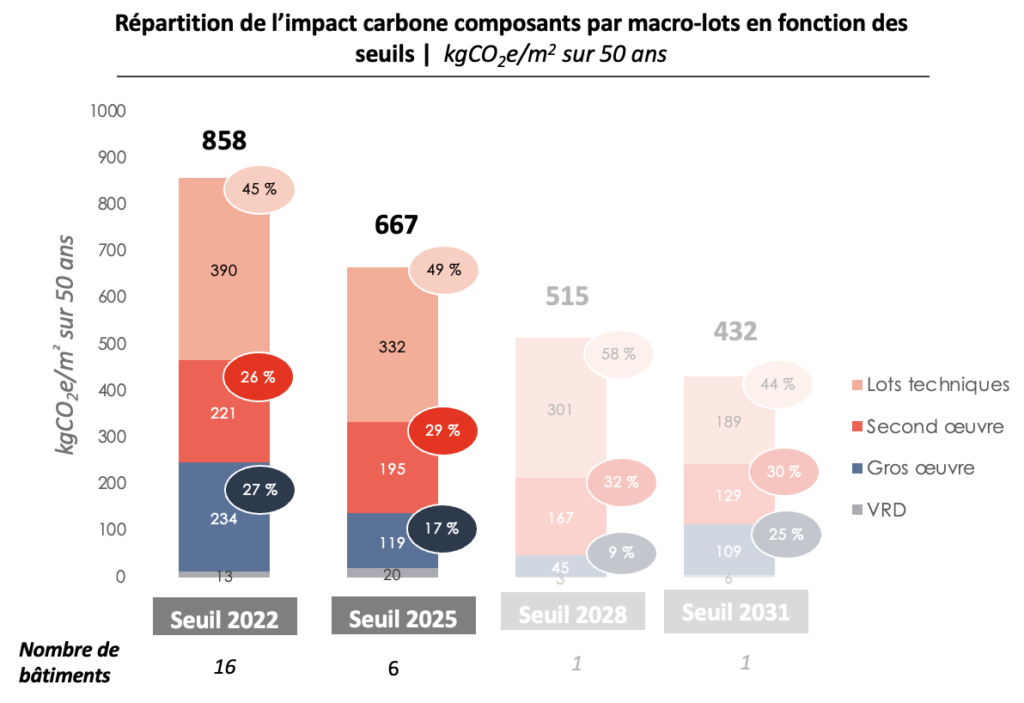
Excerpt from the Webinar of the Low Carbon Prescribers Hub: Breakdown of Carbon Impact
The sector remains largely dependent on environmental data available in databases such as INIES. Although an increasing number of products from manufacturers have specific environmental data, many components still only have default data (DED), which are often highly penalizing. To address this issue, environmental data configurators for specific products have been developed in recent years, allowing carbon impact estimates based on limited information, thereby reducing reliance on DED.
At Nooco, to help you optimize your Life Cycle Assessment (LCA) studies, we have developed an innovative feature: optimization potential. This tool allows you to quickly identify the most effective action levers to meet environmental requirements. By highlighting aspects of your project that can be improved, it helps you achieve your goals more efficiently while reducing the overall environmental impact of your constructions. This optimization potential is a valuable asset for professionals committed to complying with the strictest standards while enhancing the sustainability of their projects.