



RE2028: Low-carbon options across technical trades
The construction sector has entered an unprecedented transformation. Driven by increasingly demanding regulations, the entire value chain is shifting into gear: manufacturers are ramping up production of low-carbon materials, while builders are adopting new construction methods. The result is a steady decline in the average carbon footprint of projects.
According to a study by the Hub des Prescripteurs Bas Carbone, this footprint has already dropped by 20% in just two years. This progress stems largely from a structural shift: among a sample of multi-family housing projects tracked by the Hub, the widespread adoption of timber and low-carbon concrete has cut the carbon footprint of structural work (shell and core) by nearly 44%.
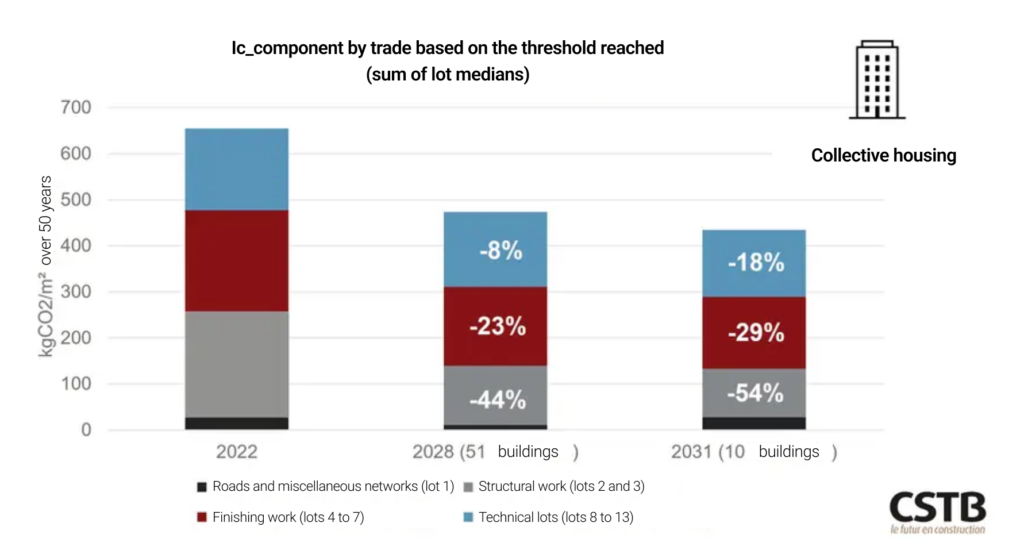
However, this virtuous trajectory is running into a major obstacle. While the structure and architectural finishes (CEA) are decarbonizing, technical trade packages are stalling. Still looking at this sample of multi-family housing, their impact is dropping by only 8%, making them the new red flag in carbon assessments. This lag is partly explained by the assembly complexity of these systems (linked to their multi-material nature) and by still-limited access to specific environmental data.
So once the building’s fundamentals have been optimized, one conclusion stands out: technical trade packages are no longer a minor detail to handle at the end of a project, but a central issue. Recall that they account for 30 to 40% of the overall carbon footprint; this is not a minor last stretch, but a full-scale undertaking in its own right. This transition has long been held back by technical, economic, and organizational barriers. Let’s look at how these barriers are being lifted today, and how to move forward in practice.
The answer now lies in activating three strategic levers: system intelligence, procurement control, and faster reuse.
1. Designing and optimizing systems: The carbon that never makes it onto the plans
The first lever for decarbonization isn’t technological, it’s quantitative. Since components account for between 50% and 75% of a building’s carbon impact, the priority is material efficiency: using less material to achieve the same function. To get there, two complementary approaches need to come together depending on the project’s stage of maturity.
A. Efficiency from the outset: optimizing building systems
Optimization begins right at the building’s design stage. While the architectural form doesn’t affect the power sizing of equipment (which remains essential to guarantee occupants’ regulatory comfort), thoughtful compactness does make it possible to centralize demand.
The issue here is material efficiency: by avoiding complex shapes, horizontal and vertical network runs are drastically reduced. It’s by cutting down on these excess linear meters that we avoid extracting and processing tons of copper, aluminum, and steel, without ever compromising the building’s technical performance.
This design intelligence enables radical system trade-offs. On a 22,000 m² office complex project in the Paris region, the engineering team optimized the heating and cooling package accordingly. By switching from a conventional “4-pipe” distribution system to a “change-over” system with just “2 pipes,” horizontal network lengths were cut in half. The result: substantial material savings and 115 tonnes of CO2 avoided, or roughly a 10% emissions reduction on that package.
Some technologies require this approach very early on, as they call for a major overhaul of the design. This is the case when switching from gas heating solutions to heat pumps (energy efficiency), or when adopting refrigerants with a very low impact (such as R490), both of which profoundly change the nature of the networks.
B. System alternatives during the execution phase
Voici la traduction :
Once the building’s geometry is locked in, the execution phase (or “exé” in French project terminology) offers a second window of opportunity. The goal is no longer to reduce distances, but to rethink the very architecture of the networks in order to track down unnecessary material.
To bring these innovations to the field, VINCI Energies France companies have developed a range of expertise led by entities already well-established in their respective fields.
- C2C and POL (Passive Optical LAN) architecture: This entity offers a complete overhaul of a project’s conventional IT network by replacing copper cabling with fiber optics. Beyond the massive savings in metals (copper, aluminum), the solution developed by C2C eliminates the need for dedicated technical rooms (VDI) on every floor. Fewer dedicated rooms means fewer scattered servers, which in turn removes the need for specific cooling systems.
- Back to DC and direct current: This company aims to promote and mainstream the use of direct current in standard commercial buildings. Instead of the conventional approach of coupling photovoltaic panels with inverters to convert energy into alternating current (a process that generates losses), Back to DC’s solution allows the network to run entirely on direct current, from production all the way to consumption. This drastically simplifies heavy infrastructure.
These companies and their technologies aren’t isolated cases; they perfectly illustrate the new role of engineering: partnering with subject-matter experts to integrate system alternatives capable of lightening a project’s carbon inventory without compromising its performance.
2. Decarbonizing through procurement: substitute and refine
While architecture reduces physical quantities, procurement strategy is the essential lever during the execution phase for turning the carbon assessment into a performance tool. Decarbonizing through procurement relies on two mechanisms: choosing lower-emission materials and hunting down penalizing data.
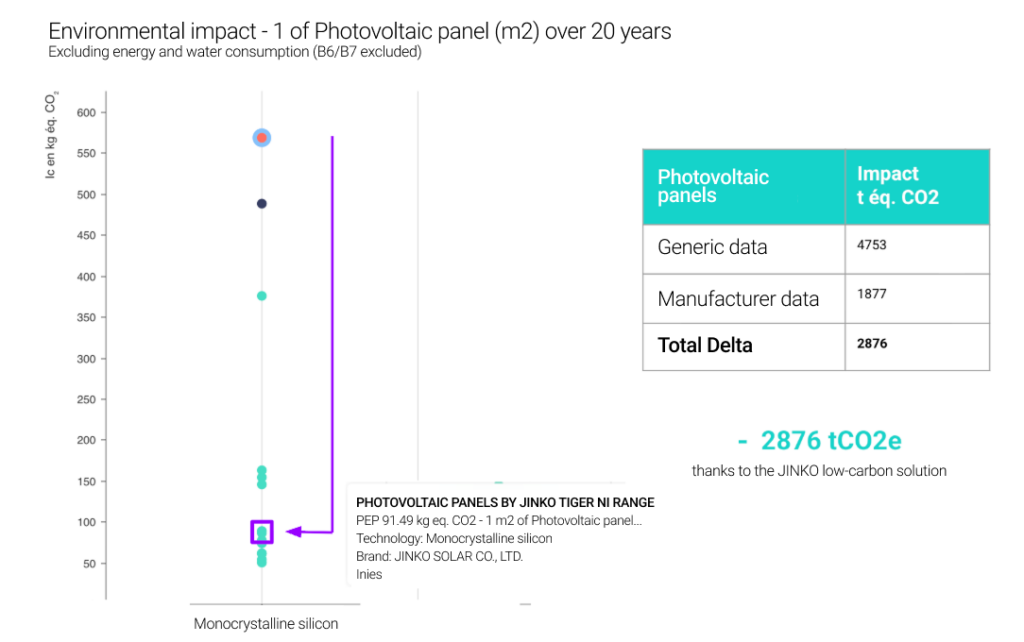
This approach first makes it possible to move away from Default Environmental Data (DED). This generic data, applied by the regulator when no precise reference is available, is deliberately pessimistic. Switching from a DED to a specific product datasheet (PEP) from a supplier that has invested in product transparency often reduces the impact of a technical trade package by 10 to 20%. The major advantage here lies in cost: this is decarbonization at constant construction cost, since it optimizes the carbon assessment on paper without changing the technical nature or the cost of the equipment on site.
The choice of energy production equipment perfectly illustrates this strategic weight. On a renovation project at a major European industrial site, the installation of more than 5,000 m² of photovoltaic canopies accounted on its own for over 80% of the operation’s carbon impact. Where generic data (DED) was weighing the project down, using specific PEP datasheets from a top-tier manufacturer made it possible to cut this package’s carbon footprint in half, avoiding nearly 3,000 tonnes of fictitious CO2 on the balance sheet.
By looking up products with a PEP datasheet in Nooco, you can quickly see this stark gap between blanket default values and manufacturer reality:
Voici la traduction :
This rigorous approach was successfully applied on a 7,000 m² public building. Careful work on supplier alternatives (both high- and low-current trade packages) and sourcing specific PEP datasheets for cable trays, cable ducts, and telephone cables made it possible to avoid emitting more than 350 tonnes of CO2 eq.
Similarly, on the renovation of a large office complex of over 15,000 m², choosing supplier alternatives backed by precise PEP datasheets for the electrical packages secured a gain of more than 35 kg of CO2 eq/m².
Finally, buyers have direct technical levers available when selecting products:
- Material substitution: for example, choosing aluminum cable over copper cable for conductors, which offers a highly efficient cost-to-carbon ratio.
- Material reduction: for example, favoring “wire mesh” cable trays over “solid bottom” trays (which are heavier in steel), whenever the project’s aesthetic constraints allow it.
With tools like Nooco, which centralizes more than 30,000 data points, the accounting exercise of Life Cycle Assessment (LCA) is turning into real-time operational management.
3. The reuse lever: repurposing what already exists to aim for zero carbon
Finally, reuse can no longer be confined to finishes or decorative elements: it is emerging as the ultimate lever for decarbonizing heavy technical infrastructure. Looking ahead to 2028, this approach is set to change status: since under RE2020 calculation rules a reused product is counted as having zero carbon impact, it becomes an essential tool for “relieving” a carbon assessment where new products retain a residual footprint.
The strength of this lever lies in its ability to reinvent our practices, particularly through the retrofit of heavy equipment (such as reconditioning Air Handling Units – AHUs) or the reuse of robust components.
On a research center project, a detailed analysis of the HVAC package showed that ductwork accounted for 31% of the package’s impact. By incorporating 25% reused circular ducting (1.1 km), the project avoided 35 tonnes of CO2 eq. This strategy was confirmed on another office project of more than 22,000 m² in Levallois-Perret, where reusing 300 meters of circular ducting (10% of requirements) significantly lightened the package’s footprint.
Reuse is even making its way into cabling, an area where safety standards are the strictest. For the construction of a public building, an installer made a breakthrough choice by replacing nearly 80% of standard distribution cables with reused cables, proving that standardized components lend themselves perfectly to a second life.
The growth of this practice is being supported by the emergence of digital platforms that list available stock in real time. Sourcing materials is no longer an uphill battle: these tools secure both logistics and material availability. Even without a mandatory regulatory quota, using secondhand components in technical trade packages has become the most direct way to secure a carbon trajectory in line with 2028 targets.
Conclusion
Meeting RE2028 thresholds is anything but a pipe dream: a third of current buildings are already achieving them, according to studies by the Hub Bas Carbone. By combining a streamlined architecture, well-chosen alternatives during the execution phase, specific manufacturer data, and a strategic use of reuse, it becomes possible to secure a carbon trajectory at a lower cost, with data intelligence advantageously replacing expensive technological solutions.
Looking ahead, the key trade-off will be to compare, right from a project’s inception, an ultra-optimized new build against a major renovation. In this second scenario, since the structure is already “written off,” the entire carbon budget can be invested in high-performance equipment. More than ever, data is becoming the essential compass for real estate value.
Sources :
- Hub des Prescripteurs Bas Carbone (IFPEB)
- Interview with Guillaume Meunier (Construction21)
- https://www.ifpeb.fr/wp-content/uploads/2025/09/092025_HUB-BAS-CARBONE_Webinaire_Public_RE2028_VF_PUBLIC.pdf (Hub des prescripteurs Bas Carbone)
- https://www.construction21.org/france/articles/h/atteindre-les-seuils-2028-de-la-re2020-sans-trop-depenser-c-est-possible.html (Interview Guillaume Meunier)