



Understanding Module D: challenges, limitations, and future perspectives
Introduction
You have likely already heard of Module D, the final step in a product’s Life Cycle Assessment (LCA).
While it is firmly established in French regulations, it remains underutilized by building industry stakeholders on the ground. The reason is simple: opinions and interpretations vary so widely that a real dichotomy has emerged between its theoretical promises and its actual use.
At Nooco, we wanted to explore how this module reflects a supplier’s commitment beyond the lifespan of their products.
At first glance, Module D is designed to encourage sustainable and virtuous practices. However, through our interviews, it appears this goal is rarely met. Viewed as too opaque, Module D is often ignored. Other decarbonization levers exist and are more widely adopted, but their scope is limited to the product’s service life.
By definition, Module D reflects manufacturer commitment
Module D is the fifth phase, or the final module, of a product’s LCA. Often referred to as “benefits and loads,” it accounts for the recovery of material and energy flows beyond the system boundaries, as well as the environmental impacts associated with these transformations. This module includes:
- Avoided impacts through material recycling (e.g., reducing the need for raw material extraction), which are counted negatively.
- Avoided impacts through energy recovery (e.g., incinerating product material instead of using other fuels), also counted negatively.
- Impacts related to the production of recycled material that were not included in the manufacturing stage (Module A), in accordance with PCR PEP Ecopassport rules, which are counted positively.
From a regulatory standpoint, Module D is defined by the NF EN 15804+A2 standard. This standard mandates that benefits and loads must be reported in Environmental and Health Declaration Sheets (FDES) and Product Environmental Profiles (PEP). Simultaneously, the impact of Module D is fully considered within the framework of the RE2020 regulation. Since Module D is often negative, it allows for the recognition of a product’s “virtuosity” beyond its own system, thereby lowering the overall environmental footprint of a piece of equipment.
It serves as a tool to highlight the environmental performance of one product over another and represents an additional step in the market’s transition toward a circular and sustainable economy.
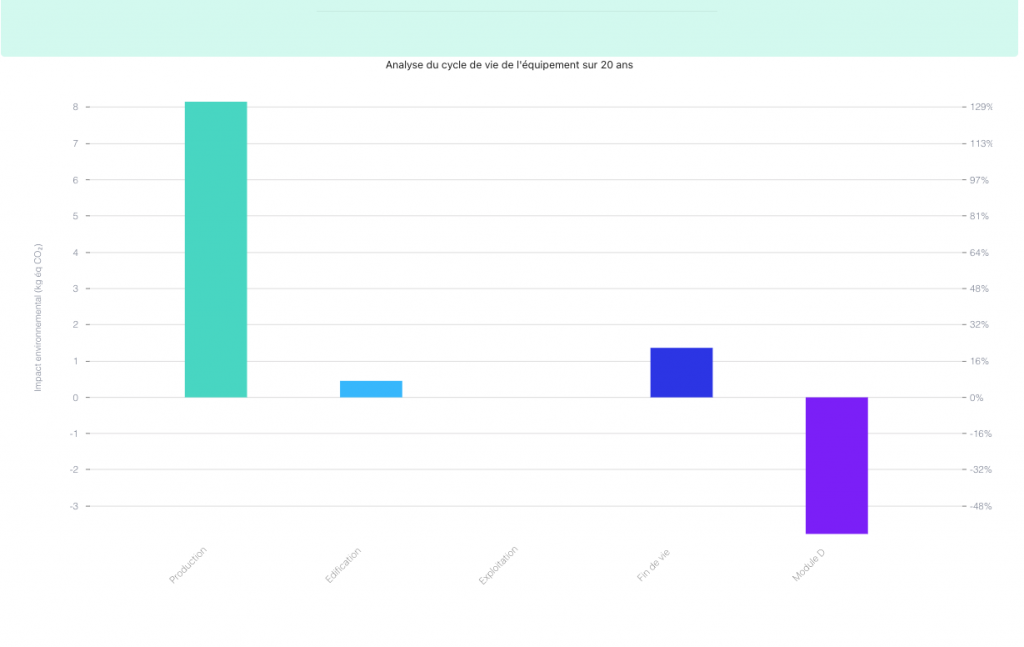
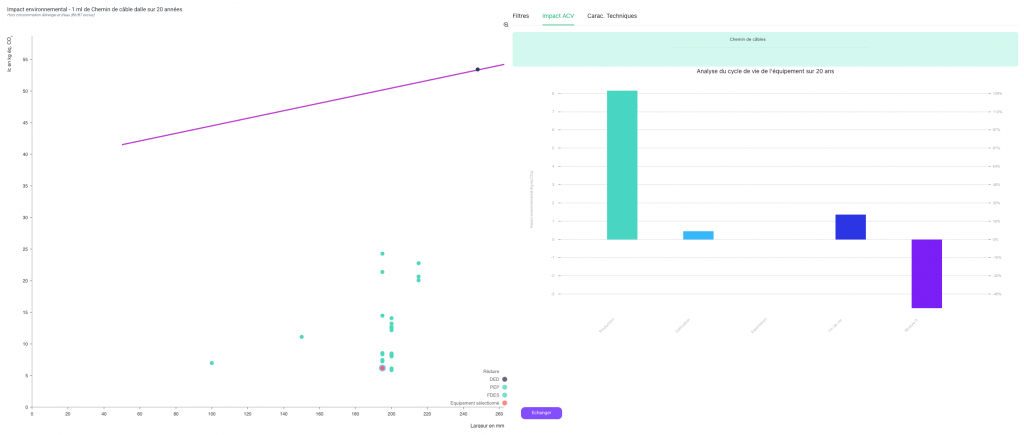
On Nooco, you can visualize the impact of your products including Module D. The following screens display the impact of an anonymized wire cable tray available in the INIES database.
- From the ‘Optimization’ module within your project”
From the Product Catalog:
A Definition that fails to translate into practice
Theoretically, Module D appears to be a cornerstone of decarbonization. However, to better understand its real-world application, we interviewed several building industry players. Their response was unanimous, though nuanced: Module D is too abstract and poorly defined to be effectively utilized. Why is this?
Lack of definition clarity
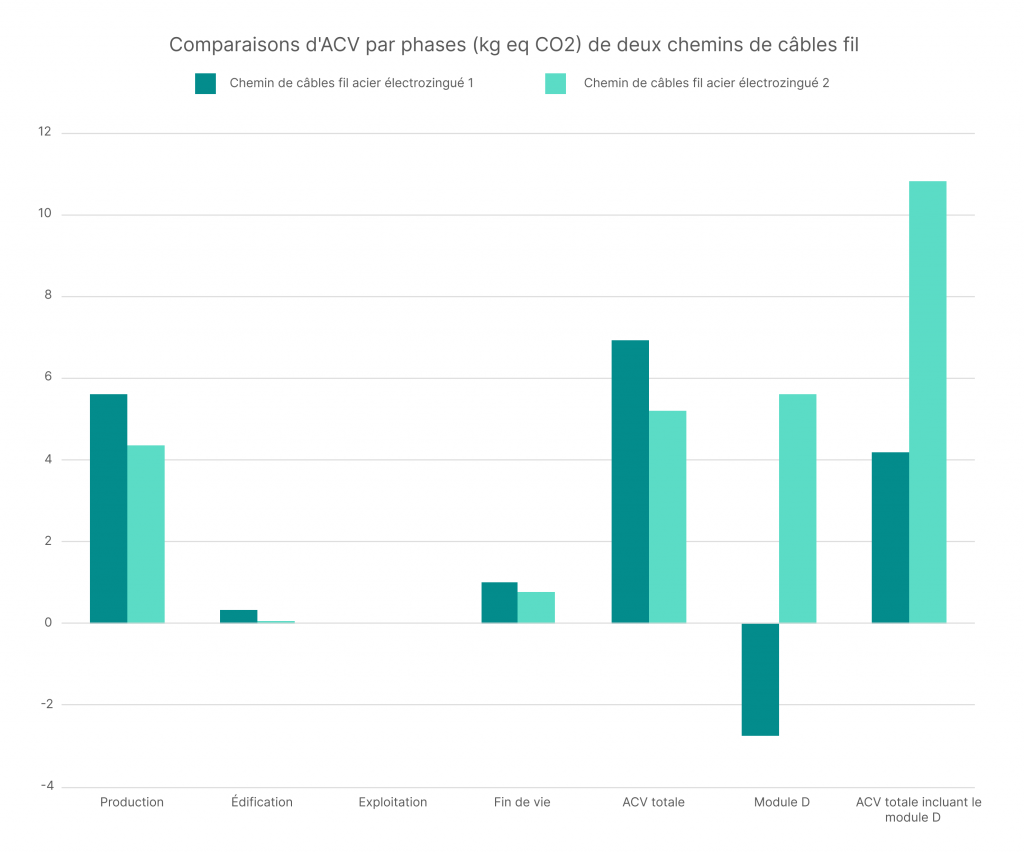
First, not all Module D results are comparable. They may originate from different PCRs (Product Category Rules) or PSRs (Product Specific Rules). Consequently, they do not follow the same specifications. This means that even LCAs for the same type of equipment may not be comparable. Béatrice Pellegrin, CSR Procurement Engineer at VINCI Énergies, anticipates this: “I only compare products from the same PCR.”
This observation proves to be particularly relevant when analyzing the graph below. This study is based on two EPDs (FDES) for electro-galvanized wire cable trays available in the INIES database. These two cable trays, originating from different PCRs, show extremely different impacts depending on whether or not Module D is included. The significant influence of benefits and loads on the overall product footprint makes this module essential. However, the lack of clarity in its definition and the resulting consequences maintain a sense of distrust within the sector.
Béatrice therefore uses Module D for indicative purposes only, choosing to exclude it from the total environmental impact of the equipment she reviews. When comparing two pieces of equipment, she uses it only as a last resort: ‘If two products have a similar environmental impact, I look at Module D to help guide my decision.
Opaque Calculations
Despite the virtuosity it represents, the limitations and the opacity of its calculation, which is based on hypotheses that are too difficult to verify, are often cited as barriers to using Module D: ‘I find Module D problematic in its interpretation,’ Béatrice confirms.
This calculation opacity paves the way for a lack of rigor and a distrust within the sector which, ultimately, prevents it from addressing the issue. ‘Opacity,’ ‘too vague,’ and ‘misunderstood’ are all terms echoed by Ivan Bordas, R&D Director at VIM, who is also responsible for drafting the PEPs for the brand’s equipment. Ivan confirms that among manufacturers, Module D is clearly not identified as a lever for optimizing the environmental impact of their products. ‘It’s just a data point like any other,’ he states. He thus demonstrates that manufacturers do not take action regarding the impacts of this final module.
And this misunderstanding extends throughout the building value chain, starting with fellow manufacturers and reaching the engineering firms that subsequently misinterpret the LCA data.
Disconnect from Manufacturer Priorities
According to Damien Cuny, co-founder and CEO of Kompozite, Module D is a regulatory innovation disconnected from the practical realities of manufacturers. He describes it as “opaque, misunderstood, and far removed from [manufacturers’] priorities: selling their products.“
As you will have gathered: despite a promising definition, the opacity of Module D leads to misunderstanding and mistrust toward it.
Nevertheless, as illustrated by Béatrice Pellegrin, Module D can still fulfill its function as a decision-making tool, particularly when it serves to differentiate between equipment with similar environmental impacts.
Furthermore, although imprecise and underutilized, Module D remains a mandatory module to complete on EPDs (FDES). So, how can it be better utilized?
Despite its unpopularity, it still contributes to encouraging more virtuous practices. For example, Ivan Bordas at VIM primarily focuses on using recyclable and recycled raw materials, such as the steel used in manufacturing equipment or the cardboard in their packaging.
Perspectives and Other Initiatives for Manufacturer Commitment
Among all the people interviewed for our questions on Module D, one thing comes up frequently: it is a poorly defined, opaque, and discouraging module for industry stakeholders. Consequently, it is not utilized.
To democratize its use, these exchanges reveal that it is paramount to provide a regulatory response to the misunderstanding surrounding Module D, but above all, it is essential to standardize databases so that all products are on a level playing field. According to Béatrice, the first step should be to unify all European databases and keep Module D for comparative purposes to encourage sustainable practices beyond the project’s physical perimeter. There would therefore be no reason to keep Module D as a mandatory module. This analysis questions the module’s relevance while highlighting its value as a decision-making tool, thereby encouraging more sustainable practices.
For Module D to be fully adopted, the surrounding ambiguity must be addressed, as Ivan points out: ‘Module D calculations should be clarified with a few representative examples of real-life cases,’ and there is also a need for ‘a popularization of the subject to enable better understanding and, ultimately, better use.’
Indeed, a better understanding of benefits and loads is a prerequisite for its adoption. When asked about adapting his practices to achieve a high-performance Module D, Ivan replies: ‘yes, provided that Module D is better understood, better defined, and used correctly.’
Module D is in competition with practices that are already clearly identified, mastered, and whose effectiveness is known. Damien explains that the most pragmatic initiatives are the most adoptable ones: ‘Manufacturers have identified other more relevant decarbonization axes, notably energy performance and optimization (for both economic and ecological reasons) and eco-design.’
Another practice, which was not mentioned during the interviews but is crucial for reducing project impacts, exists: reuse (see Nooco article). Still not widely democratized, reuse has become a must-have in decarbonization challenges thanks to its environmental impact being considered zero within the regulatory framework.
At Nooco, we encourage reuse (see publication: Reuse and standards in the building sector). As an example, we recently made cables from the Circable initiative available to Vinci Energies companies—a company that reuses power cables. This new addition covers four cable ranges, which see their impact reduced to 0 kgCO2eq.
This initiative allows for the visualization of carbon gains achieved by implementing reuse, while contributing to its popularization.
Conclusion
Module D reflects sustainable values that extend beyond the physical and temporal scope of a piece of equipment or material. It is mandatory to report it in EPDs (FDES), and its impacts are taken into account under RE2020 regulations. Although clearly defined by regulation, its use remains limited among building industry stakeholders.
Yet, this module holds potential as a decision-making tool or as an indicator of equipment circularity. Based on this principle, it reflects a commitment from manufacturers wishing to optimize their products’ impacts beyond their service life. However, the complexity of its calculation hinders its adoption, leading to a certain degree of confusion and, ultimately, distrust within the sector.
Conversely, other decarbonization levers that are more concrete and better mastered—such as eco-design, energy performance, or reuse—are more readily adopted because they offer immediate and more tangible carbon gains.