



In 2023, INIES remained active despite slower-than-expected growth.
INIES database showed only a 13% growth between the end of 2022 and the end of 2023. However, this figure does not reflect the full scope of activity related to manufacturer-submitted datasheets (where “activity” refers to the sum of newly created, deleted, and modified entries):
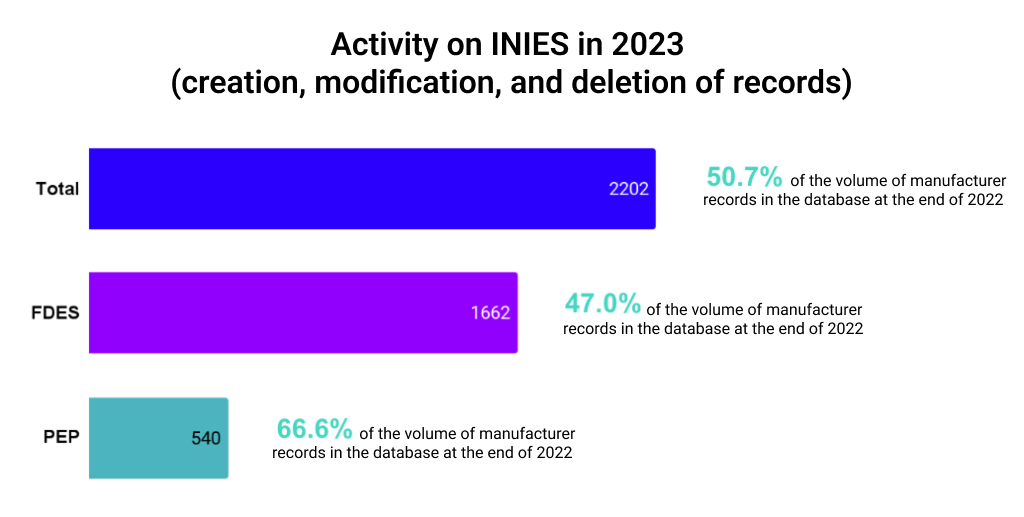
- In 2023, activity related to manufacturer datasheets totaled 2,202 instances, which corresponds to 50.7% of the total number of datasheets available in the database at the end of 2022. For PEP (Product Environmental Profiles) datasheets in particular, activity reached 66.6% of the 2022 total.
- There were 1,311 new datasheets created in 2023, while only 68 were deleted. Notably, these figures do not account for the growing number of product ranges, which reflect improvements in both the comprehensiveness and quality of published datasheets.
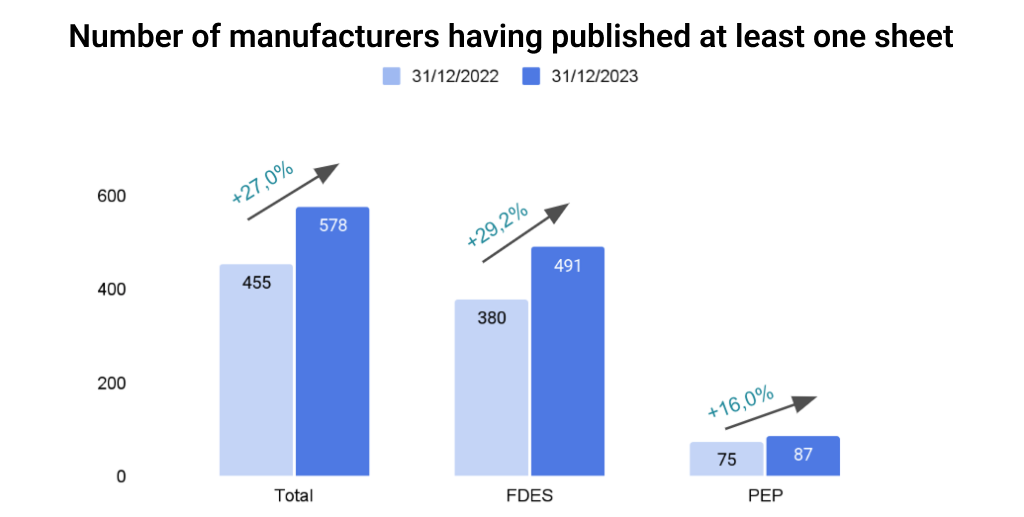
- However, the number of manufacturers contributing to the database only grew by 27%. In the case of PEP datasheets, manufacturers face more significant barriers to entry, largely due to the technical complexity of the equipment involved, which makes carbon tracking more challenging.
Let’s take a closer look at what this means and examine the remaining challenges ahead.
What Is the INIES Database?
INIES is France’s reference environmental and health database for the building sector.
Its primary goal is to provide recognized and verified data — particularly carbon data — to support assessments under the RE2020 environmental regulation. The database includes life cycle analyses (LCAs) of construction products and building equipment.
INIES is organized as a multi-stakeholder initiative, designed to ensure ethical and transparent governance through a semi-public oversight structure.
Launched in 2005, the database began to expand significantly during the 2010s and experienced rapid growth following the implementation of RE2020 in 2022.
Several types of data are available on INIES:
- Specific data: supplied by manufacturers and corresponding to real, market-available products
- Generic data: provided by the CSTB (Scientific and Technical Centre for Building), commissioned by the Department of Housing, Urban Planning and Landscapes under the Ministry for Ecological Transition, used when specific data is unavailable
The different product declarations listed in the database:
| Default Environmental Data (DED) | Generic building data provided by the ministry responsible for construction in the absence of specific data. These values are conservative, as they are calculated using safety factors. |
| Environmental and Health Declaration Sheet (FDES) | Manufacturer’s datasheet presenting the Life Cycle Assessment (LCA) of a construction or decoration product. |
| Product Environmental Profile (PEP) | Manufacturer’s datasheet presenting the Life Cycle Assessment (LCA) of an electrical, electronic, or HVAC equipment. |
| Conventional Environmental Data (DEC) | Average carbon impact of energy consumption, water use, or waste management depending on their nature and usage. |
| Default values / Packages | Generic data available for certain trades (HVAC, CFO, CFA) providing an upper bound of carbon impact per m², usable in the absence of precise data. |
Data Verification Processes
The verification processes differ depending on the type of data:
- For FDES, the verification process is managed internally by INIES.
- For PEP, the data is verified by PEP Ecopassport before being integrated into INIES. PEP Ecopassport is a non-profit association aimed at developing Life Cycle Assessments (LCA) for electrical, electronic, and HVAC products internationally.
- In both cases, the data is reviewed by recognized external auditors.
Activity of the database in 2023
Key developments to note:
- Despite a slower than expected increase in the number of records on INIES, overall activity remains dynamic with 2,202 creations, modifications, and deletions of manufacturer records.
- The number of manufacturers publishing PEPs is growing more slowly than those publishing FDES.
However, when looking at record activity, the trend is reversed:- It is challenging for PEP manufacturers to enter the INIES market because the required investments are high: the products are complex and require strong internal expertise to calculate their life cycle assessment (LCA).
- On the other hand, although the entry cost to produce a PEP is high, it is amortized by the market share to be gained and the benefits of publishing future records.
- Consequently, PEP manufacturers already established in the market publish a lot, notably because a large part of the market remains uncovered: 293 PEP records were published in 2023 while the database contained 810 PEPs at the end of 2022 (37% activity).
- The creation of records is more concentrated for PEPs than for FDES: on average, there are 1.8 FDES creations per manufacturer compared to 3.4 for PEPs.
There are 1,660 DEDs in 2023, representing a 7% increase compared to 2022. The growth of DEDs is modest, partly because their use in regulatory projects is expected to decline as the number of manufacturer-specific datasheets increases.
Looking at their current interactions, let’s assess the impact of generic datasheets on the creation of manufacturer-specific datasheets:
- In structural work and architectural trades: DEDs tend to be conservative (overestimating impacts), and the number of manufacturer datasheets is high. Manufacturer datasheets are preferred because DEDs generally do not allow meeting regulatory thresholds.
- In technical trades: The relevance of DEDs compared to verified INIES products varies. Some DEDs are underestimated (e.g., Air Handling Units or luminaires), and the forfait for the “High Voltage” lot is protective, which can actually hinder manufacturers from publishing their data.
Source : Baromètre INIES 2023 / Baromètre INIES 2022 / Baromètre INIES 2021
New developments in RE2020 regulations
The amendment to the EN 15804 A2 standard in November 2022 introduced two major changes:
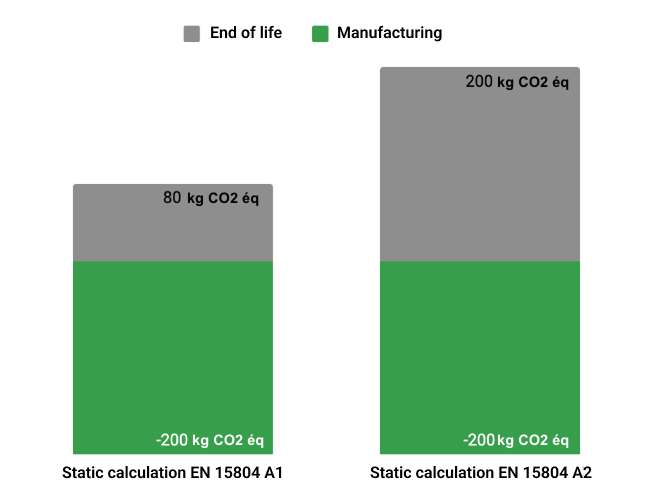
- Carbon-neutral biogenic cycle: Carbon stored in the product is now considered to be 100% re-emitted at the end of its life.
Comparison of calculations for bio-based products (which store carbon) between standards A1 and A2 (kg CO2 eq)
- Mandatory calculation of module D (potential for recycling, reuse, and recovery), even if it is a burden: previously, this calculation was optional and therefore almost only included when favorable.
Note: Any environmental declaration published after December 2022 must comply with standard A2. Declarations published under standard A1 remain valid until December 31, 2025.
In addition to these two major methodological changes, the standard requires the calculation of new indicators, notably the breakdown of the climate change indicator into three parts: fossil, biogenic, and land use-related emissions.
Ultimately, the evolution in both the quantity and quality of data is crucial to making the construction market a mature one, and to securing its role as a pioneer in reducing the carbon impact of industrial activities. However, this is not a sufficient condition for generating added value through carbon. At Nooco, we are convinced that it is the field professionals who must take ownership of the data. And that’s exactly what we work toward every day!
Appendix: Evolution of Equipment Declarations Available on INIES Between 2021 and 2023
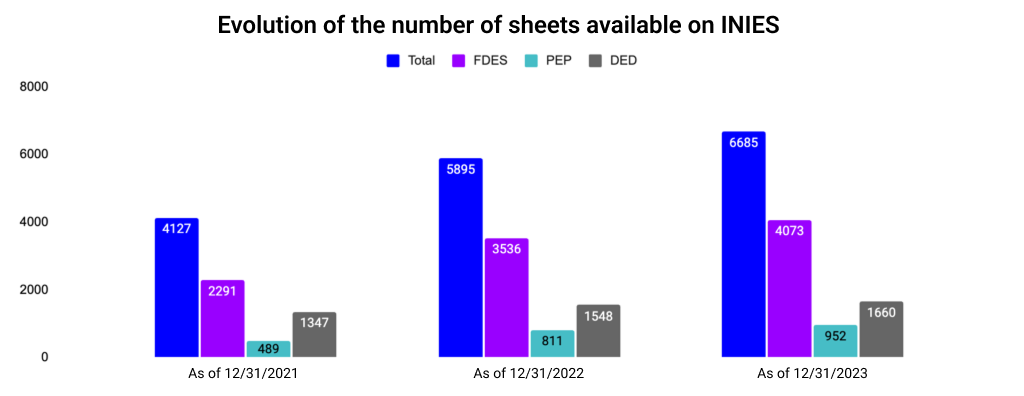
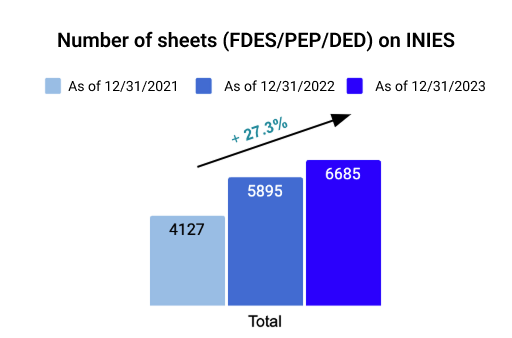
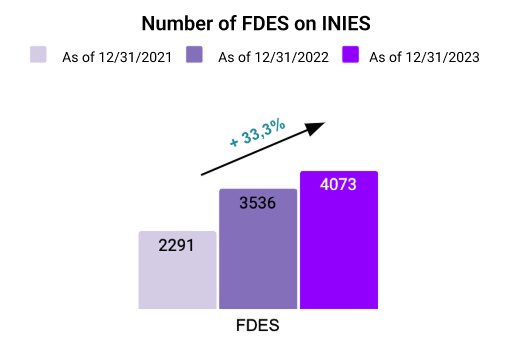
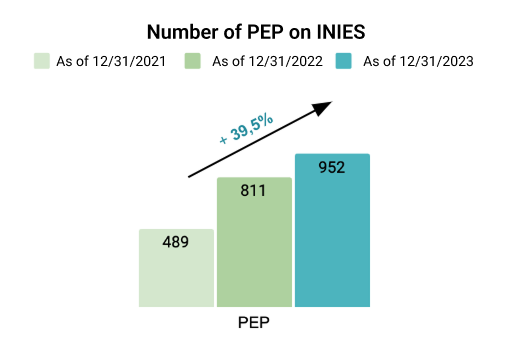
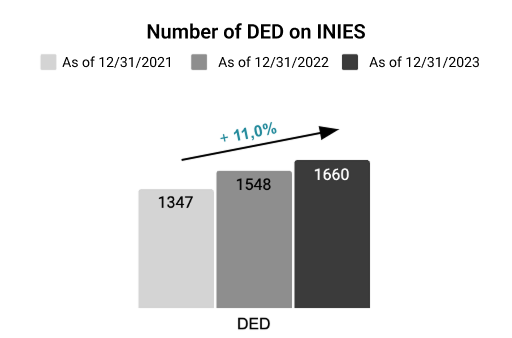
All figures are as of 12/31/2023
Sources : Baromètre INIES 2023 / Baromètre INIES 2022 / Baromètre INIES 2021