


RICS WLCA: a benchmark for steering building decarbonisation in the UK
From 2028, the European directive 2024/1275 (EPBD, Energy Performance of Buildings Directive) requires every member state to measure life cycle assessment (LCA) in the building sector. This requirement calls for national regulations, already under way in several countries such as France with the RE2020.
The challenge is the same in the United Kingdom. The Royal Institution of Chartered Surveyors (RICS) has developed the Whole Life Carbon Assessment (WLCA), a methodology that aims to bring more clarity and precision to calculation methods.
Although British in origin, the standard was designed to have a global reach. It builds on two international frameworks: ISO 14040/44, which sets the methodological framework for LCA, and EN 15978, which describes the principles for assessing the environmental performance of buildings.
This article first looks at the key differences between the requirements of the RE2020 and the RICS standard, before exploring its impact worldwide.
WLCA vs RE2020: where the methods differ
The RE2020 and the RICS WLCA standard share the same overall goal of reducing emissions, but they work differently. The French regulation sets a fairly rigid framework to check the compliance of new buildings. The RICS offers a flexible methodology designed for investment and asset management on an international scale.
The WLCA is a voluntary method whose main purpose is to guide the calculation of emissions. The RE2020, by contrast, has a real reduction goal, through thresholds that become stricter over the years.
The WLCA methodology covers all building types (housing, offices, retail, public facilities, etc.). It applies to new construction, reconstruction, renovation, refurbishment and fit-out.
The table below sets out the main features of the RICS methodology and how they differ from the RE2020.
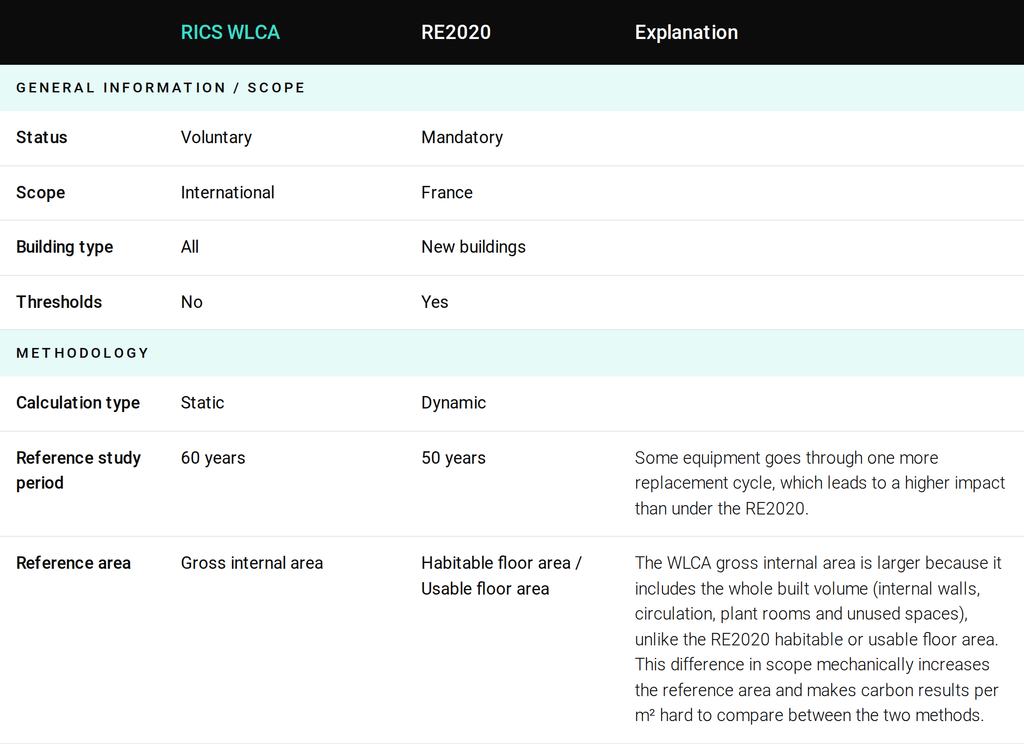
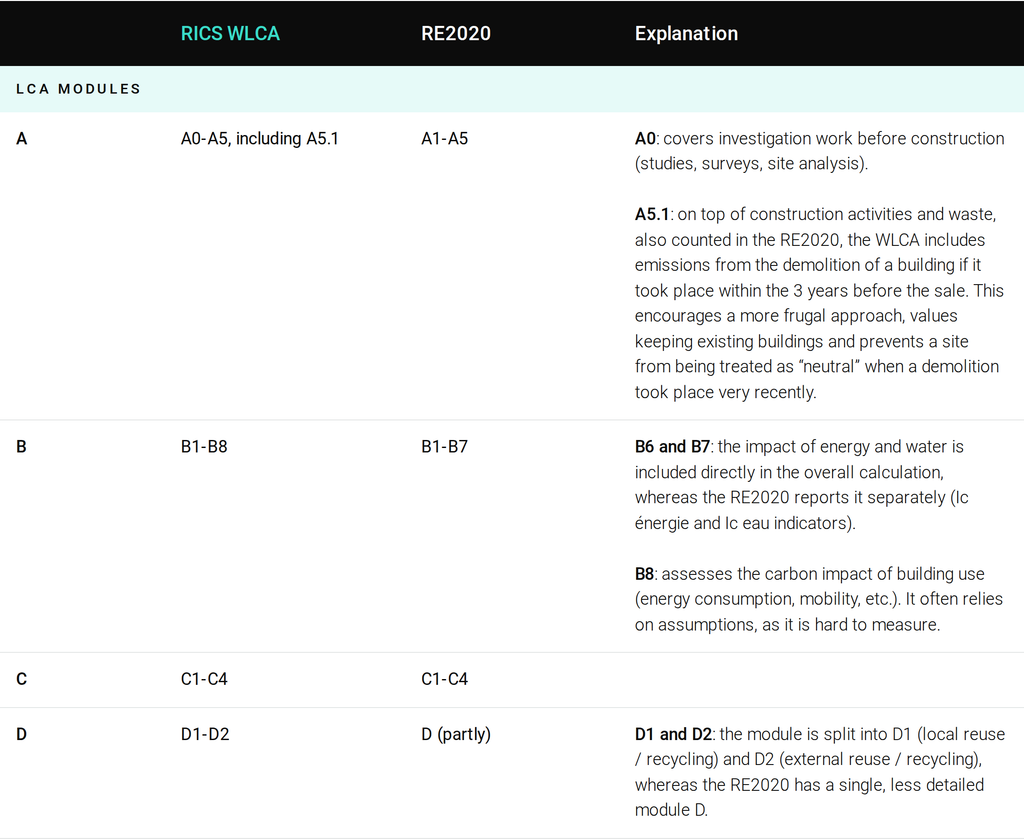
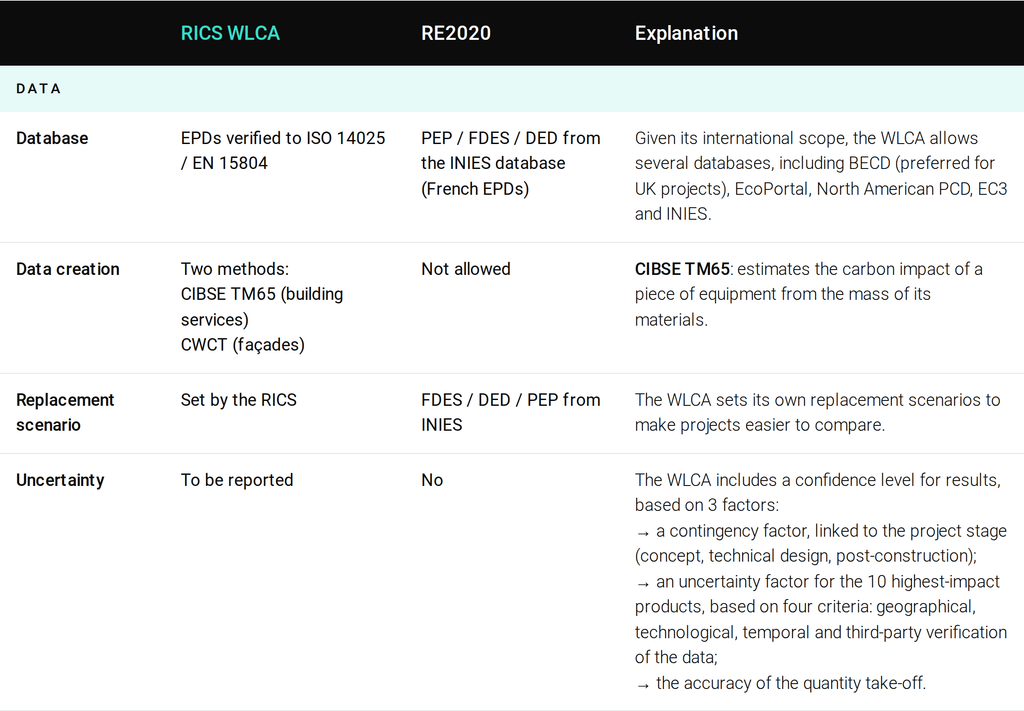
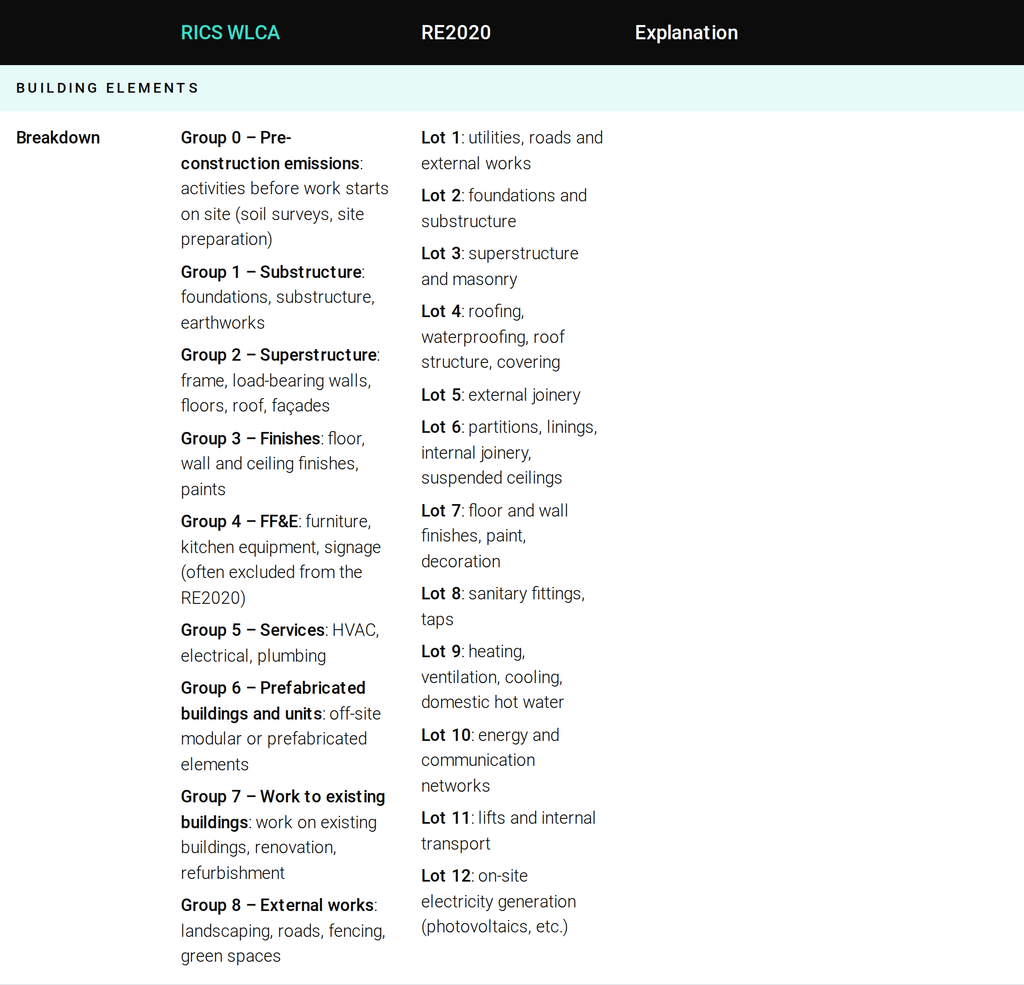
Beyond these methodological differences, the strength of the RICS standard lies in its change of scale. Where the RE2020 stops at the borders of French regulatory compliance, the WLCA stands out as a global tool for financial and non-financial management. By creating a common carbon language worldwide, it brings environmental impact right into investors’ balance sheets and international sustainability reports.
RICS WLCA: adoption beyond the UK
The standard was designed to avoid a patchwork of national methods, with a methodology that can be used anywhere in the world. In the UK, the WLCA methodology is already used in some contexts: the City of London, for example, requires an LCA for every project at planning application and after completion. But the RICS methodology reaches well beyond British borders.
Ireland: WLCA on track to become the common basis
To align with the EPBD requirements, Ireland is taking part in the INDICATE project. This programme supports several member states, including Spain, Italy and Austria, in carrying out LCAs to set national benchmarks. Within this framework, the RICS WLCA methodology has been used as technical support, in particular for its nine-group classification structure.
Australia: the case of infrastructure
Transport for NSW has made the RICS standard mandatory for assessing the carbon impact of its projects (metros, bridges, tunnels).
One of the first applications was on an infrastructure pipeline worth more than $70 billion. The WLCA gave every cost line a carbon equivalent, so that the financial budget and the carbon budget could be managed side by side.
United Arab Emirates
The standard serves as the technical basis for project LCAs through a strategic partnership with Expo City Dubai.
In practice, it is used to steer the decarbonisation of Expo City Dubai, which will house 35,000 residents and needs to reassure international investors about the reliability of its ESG data.
India
In India, the challenge is to find a methodology suited to the country’s context: high construction intensity and a predominance of concrete. The RICS has therefore adapted its text and published India-specific guidance. In practice, the document recommends building an India-specific carbon inventory, rather than relying on European databases that are often ill-suited to local conditions.
Conclusion : from local regulations to a global ambition, towards unified low-carbon standards
RE2020 and RICS WLCA: a shared foundation
The RE2020 and the RICS WLCA differ in how they apply: one is a national regulation, the other a voluntary international standard. Yet they rest on a common core. Both build on EN 15978 and on a very similar breakdown of the life cycle, and both reflect the same shift: going beyond operational carbon to measure a building’s carbon footprint from construction to demolition. This helps avoid counterproductive decisions, such as adding carbon-intensive materials to save a smaller amount of energy.
Different scales, one ambition
Their differences do not reflect a methodological disagreement, simply an adaptation to their own markets. Where the RE2020 is the strict regulatory framework in France, the RICS WLCA offers a universal approach that can adapt to any asset.
The same variations in nuance and scope can be found in other major schemes in the sector, such as BREEAM, LEED, LCBI and Minergie.
Nooco: one operational platform for a shared framework
This variety of methodologies now fits into a global ecosystem. Nooco brings together the requirements of the different methodologies (RE2020, RICS, BREEAM, LEED, LCBI, Minergie), showing that these approaches are not siloed.
In this sense, they complement each other. Their convergence is a sign of a maturing sector: measuring a building’s carbon over its whole life cycle is no longer optional, it is a global standard.
The RICS does not replace national regulations; it acts as a complementary reporting framework. While the RE2020 drives technical change in France through its thresholds, the RICS WLCA only provides a data structure, which may be its main limitation. Unlike the French framework, the international standard sets no minimum environmental ambition. A building can fully comply with the RICS method while showing a very high carbon footprint.
Even so, its growing international adoption comes from its ability to offer a common language. By working alongside the GHG Protocol for carbon accounting, ICMS 3 for cost structure, and GRESB and PCAF for portfolio analysis, the RICS WLCA is well placed to become a global reference.
Source