



Carbon footprint: monetary ratios or LCA?
What is the significance of the gap between ADEME’s monetary emission factors, often used in corporate carbon accounting, and LCA data used for carbon calculations in construction projects?
Assessing the carbon footprint in the building sector has become a critical priority to meet increasing environmental requirements. In this context, professionals often rely on monetary emission factors provided by ADEME (the French Agency for Ecological Transition) to estimate their greenhouse gas (GHG) emissions.
Understanding data is essential to enable coherent and achievable transition plans.
Environmental impact of the products studied according to the two methods (kg CO₂ eq/m²)

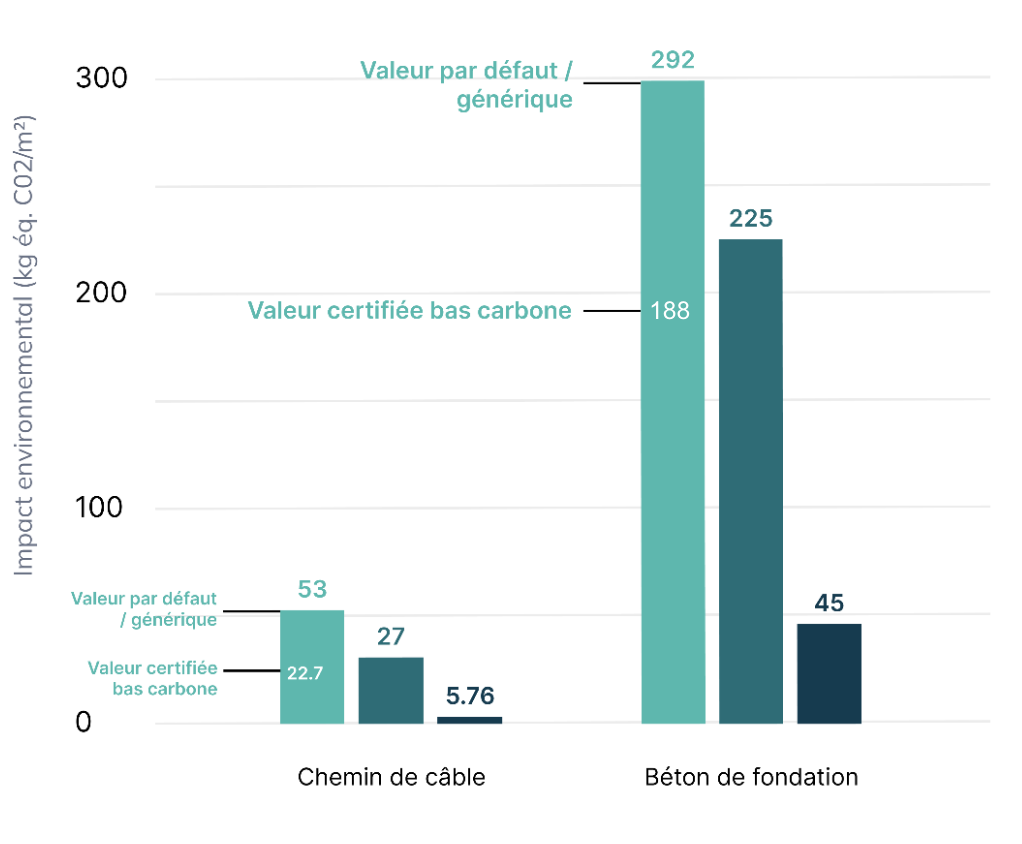
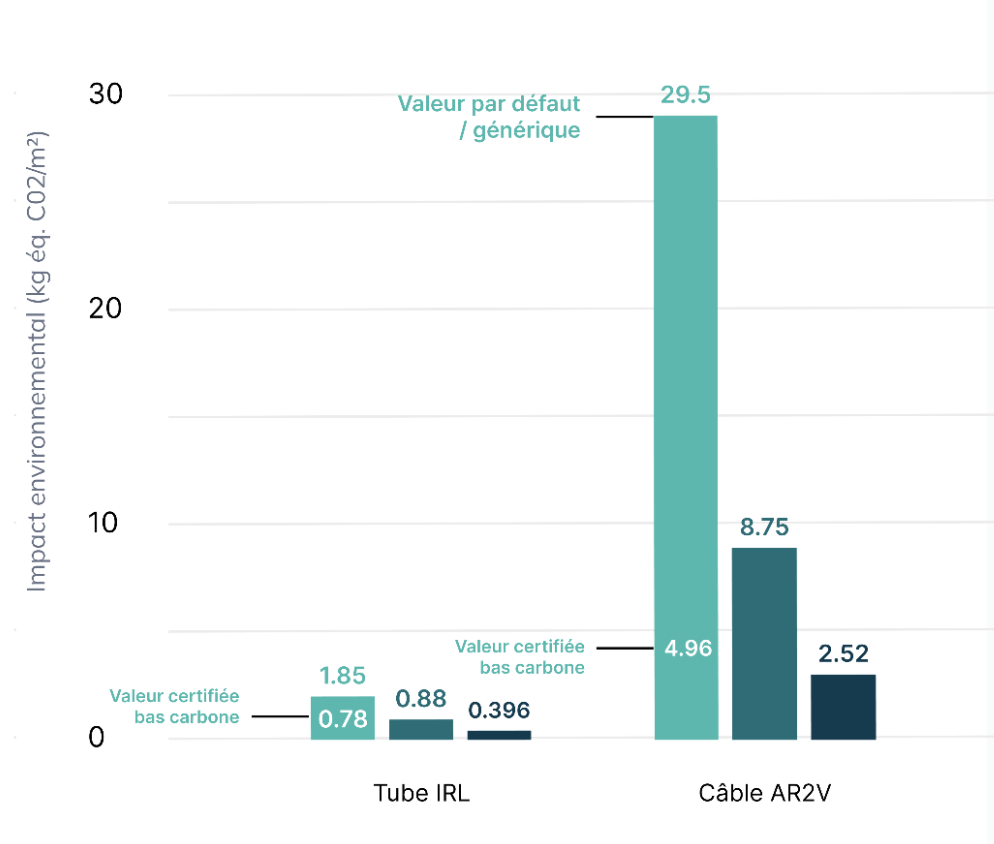
We compared above the carbon impact of several products obtained using two methods — monetary ratio (ADEME) and LCA (DED from the INIES database):
- Steel cable tray, 195 mm wide (1 m)
- Blinding concrete (1 m³)
- IRL conduit DN 17 & 20 (1 m)
- AR2V mono 240 cable (1 m)
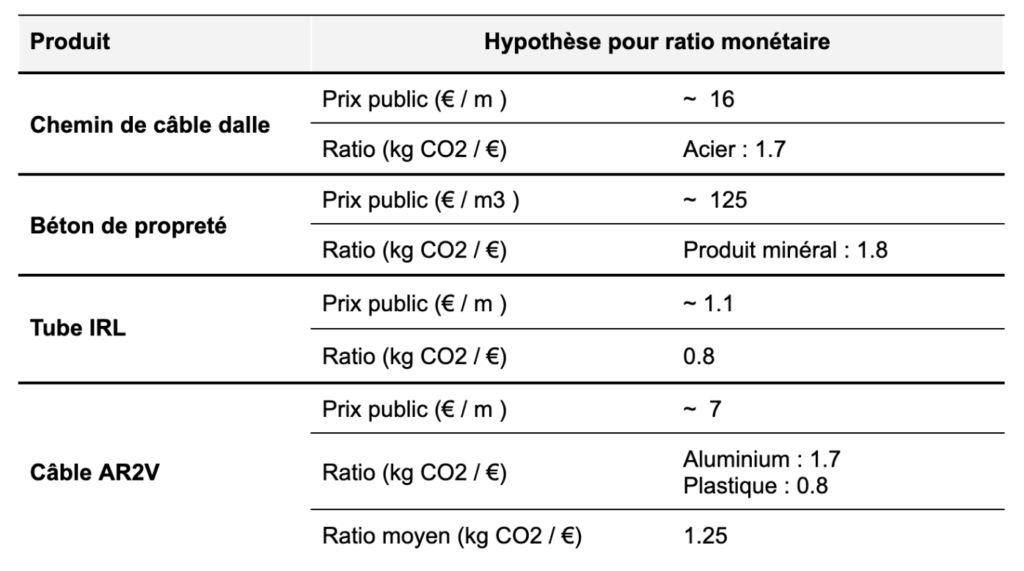
The results based on monetary ratios tend to fall between default LCA values and certified low-carbon data.
Scope Difference
ADEME’s monetary ratios provide average estimates of greenhouse gas emissions by sector or material. They are well-suited for high-level carbon footprints, typically used in corporate reporting or monitoring environmental commitments.
In contrast, Life Cycle Assessment (LCA) offers a detailed analysis of a product’s environmental impact across its entire life cycle, including the specific manufacturing technology, geographic context of the processes, and more—making it a precise tool for evaluating individual projects.
Limitations
While less precise, the monetary ratio method allows for a quick translation of accounting data into carbon data. This approach is widely adopted by many companies but comes with several limitations:
- Calculations are affected by inflation and purchase prices
- Emissions reduction strategies are limited to reducing revenue
- Low-carbon alternatives cannot be properly recognized
- Data is rarely updated
LCA (Life Cycle Assessment) data, on the other hand, provides accurate calculations and enables the development of a concrete transition plan for the company. However, this approach is more complex to implement due to:
- The need for an annual extraction of purchases with structured and detailed data
- The difficulty in linking this data to specific environmental data
- The potential lack of data for certain products
Conclusion
The ADEME monetary ratios are useful for quick carbon reporting and for providing an initial estimate of environmental impact. However, as discussed earlier, these ratios quickly show their limitations.
Only physical methods—though more complex to implement—such as product-based Life Cycle Assessments (LCAs), allow for the proper recognition of low-carbon alternatives introduced as part of a carbon transition and reporting plan.
A hybrid approach may be considered initially, combining the advantages of monetary ratios and physical methods, especially for products that lack available LCA data.
Sources
INIES
Cable tray – perforated/solid (DED) : https://www.base-inies.fr/iniesV4/dist/consultation.html?id=29373
Cable tray – perforated/solid (PEP) : https://www.base-inies.fr/iniesV4/dist/consultation.html?id=38187
Blinding concrete (DED) : https://www.base-inies.fr/iniesV4/dist/consultation.html?id=31629
Blinding concrete (FDES) : https://www.base-inies.fr/iniesV4/dist/consultation.html?id=37701
IRL tube (DED) : https://www.base-inies.fr/iniesV4/dist/consultation.html?id=28942
IRL tube (PEP) : https://www.base-inies.fr/iniesV4/dist/consultation.html?id=25975
AR2V Aluminum cable (DED) : https://www.base-inies.fr/iniesV4/dist/consultation.html?id=32675
PEPecopasseport
AR2V Aluminum cable : https://register.pep-ecopassport.org/pep/consult/mbesqrsCBZbWbKJq6-kJ3qUUeb8E8wHq0yU6oTQ-xTw/mbesqrsCBZbWbKJq6-kJ3nXTEwaL2H-VUQApFU2-Q6g
ADEME
Monetary ratio : https://base-empreinte.ademe.fr/donnees/jeu-donnees
Prices
Prices correspond to average observed market retail prices..